

How to Find Your Ring Size
The most reliable way to determine your ring size is to visit one of our specialists in person, where we can measure your finger using professional sizing tools. However, we understand that isn't always possible — especially when a proposal is in the works! Below are two straightforward methods you can use at home.
Method 1 — Measure Your Finger
Use a strip of paper or a thin piece of string to measure the circumference of your finger.
- Cut a thin strip of non-stretch paper or use a length of string.
- Wrap it snugly around the base of the finger you intend to wear the ring on.
- Mark the point where the strip meets itself.
- Lay the strip flat and measure the length in millimetres.
- Match that measurement to our UK ring size chart below.
Method 2 — Measure an Existing Ring
If you already own a ring that fits well, you can use it to find your size in seconds.
- Select a ring that fits the correct finger comfortably.
- Place it on a flat, well-lit surface.
- Using a ruler, measure the inner diameter across the widest point in millimetres.
- Refer to our UK ring size chart to identify your size.
- If between two sizes, we recommend choosing the larger for comfort.
UK Ring Size Chart
The UK ring sizing system runs alphabetically from A (smallest) to Z+ (largest), with half-size increments available for a more precise fit. Each letter corresponds to the ring's inner circumference in millimetres. Use the table below to match the diameter or circumference of your finger measurement to the correct UK ring size.
Please note: your ring finger size may differ from your other fingers, and your left hand may measure slightly differently from your right.
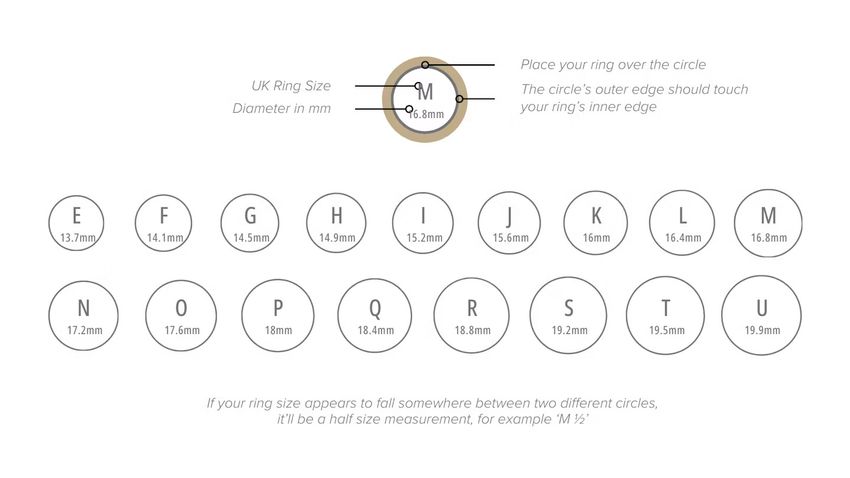
| Ring Size (UK) | Inside Diameter (mm) | Inside Circumference (mm) |
|---|---|---|
| E | 13.7 | 43.0 |
| E ½ | 13.9 | 43.6 |
| F | 14.1 | 44.3 |
| F ½ | 14.3 | 44.9 |
| G | 14.5 | 45.5 |
| G ½ | 14.7 | 46.2 |
| H | 14.9 | 46.8 |
| H ½ | 15.1 | 47.4 |
| I | 15.2 | 47.8 |
| I ½ | 15.4 | 48.3 |
| J | 15.6 | 49.0 |
| J ½ | 15.8 | 49.6 |
| K | 16.0 | 50.3 |
| K ½ | 16.1 | 50.5 |
| L | 16.4 | 51.5 |
| L ½ | 16.6 | 52.1 |
| M | 16.8 | 52.8 |
| M ½ | 17.0 | 53.4 |
| N | 17.2 | 54.0 |
| N ½ | 17.4 | 54.6 |
| O | 17.6 | 55.3 |
| O ½ | 17.8 | 55.9 |
| P | 18.0 | 56.5 |
| P ½ | 18.2 | 57.1 |
| Q | 18.4 | 57.8 |
| Q ½ | 18.6 | 58.4 |
| R | 18.8 | 59.0 |
| R ½ | 19.0 | 59.6 |
| S | 19.2 | 60.3 |
| S ½ | 19.4 | 60.9 |
| T | 19.5 | 61.2 |
| T ½ | 19.7 | 61.9 |
| U | 19.9 | 62.5 |
Average Ring Sizes in the UK
Ring size varies from person to person and is broadly influenced by factors such as height, body build, and overall hand size. While there is no universal formula, knowing the average ring size for men and women in the UK can be a helpful starting point — particularly when buying a surprise gift or engagement ring.
L
T
Please note: These averages are a guide only. Every individual is unique and the only way to guarantee the correct fit is to have your finger measured professionally. Our Bond Jewellery & Diamonds team are happy to help — book an appointment at your convenience.
Ring Size Conversion Chart
Ring sizing conventions differ around the world. The UK uses an alphabetical system (A–Z), while the United States and Canada use numbers, and continental Europe uses a numerical circumference-based scale. If you have purchased a ring abroad or are shopping from an international brand, use our conversion chart to find the equivalent UK size.
A common question we receive is: "What is a US ring size 7 in the UK?" — using the table below, you can see that a US size 7 corresponds to UK size N ½.
| Ring Size (UK) | Ring Size (US) | Ring Size (EU) | Inside Diameter (mm) |
|---|---|---|---|
| E | 2 ½ | 42 ¾ | 13.7 |
| E ½ | 2 ¾ | 42 ¾ | 13.9 |
| F | 2 ⅞ | 44 | 14.1 |
| F ½ | 3 | 44 ⅝ | 14.3 |
| G | 3 ¼ | 45 ¼ | 14.5 |
| G ½ | 3 ½ | 45 ⅞ | 14.7 |
| H | 3 ¾ | 46 ½ | 14.9 |
| H ½ | 4 | 47 ⅛ | 15.1 |
| I | 4 ¼ | 47 ¾ | 15.2 |
| I ½ | 4 ½ | 48 | 15.4 |
| J | 4 ¾ | 48 ¾ | 15.6 |
| J ½ | 5 | 49 | 15.8 |
| K | 5 ¼ | 49 ⅝ | 16.0 |
| K ½ | 5 ½ | 50 ¼ | 16.1 |
| L | 5 ¾ | 50 ⅞ | 16.4 |
| L ½ | 6 | 51 ½ | 16.6 |
| M | 6 ¼ | 52 ⅛ | 16.8 |
| M ½ | 6 ½ | 52 ¾ | 17.0 |
| N | 6 ¾ | 53 ⅜ | 17.2 |
| N ½ | 7 | 53 ¼ | 17.4 |
| O | 7 ¼ | 54 | 17.6 |
| O ½ | 7 ½ | 54 ⅝ | 17.8 |
| P | 7 ¾ | 55 ¼ | 18.0 |
| P ½ | 8 | 55 ⅞ | 18.2 |
| Q | 8 ¼ | 56 ½ | 18.4 |
| Q ½ | 8 ½ | 57 ⅛ | 18.6 |
| R | 8 ¾ | 57 ¾ | 18.8 |
| R ½ | 9 | 58 ⅜ | 19.0 |
| S | 9 ¼ | 59 | 19.2 |
| S ½ | 9 ½ | 59 ⅝ | 19.4 |
| T | 9 ¾ | 60 ⅞ | 19.5 |
| T ½ | 10 | 61 ½ | 19.7 |
| U | 10 ¼ | 61 ⅛ | 19.9 |
Expert Tips for Getting the Size Right
Our specialists have sized thousands of rings. Here is their trusted advice to help you achieve a perfect fit every time.
- Visit a professional jeweller whenever possible. At Bond Jewellery & Diamonds, we offer complimentary ring sizing appointments at our showroom, where you can try several sample sizes for a confident, accurate result.
- Normalise your hand temperature before measuring. If your hands are particularly hot or cold, run them under lukewarm water for a minute to bring them to a neutral temperature.
- Use non-stretchable material when measuring at home. Elastic string or stretchy fabric will compress against the finger and give an inaccurately small reading.
- Measure at least three times and across different times of day. This accounts for natural fluctuations and gives you a more dependable average.
- Factor in your knuckle when choosing a size. If your knuckle is notably wider than the base of your finger, select a size that slides over the knuckle comfortably, but isn't excessively loose when seated.
- Consider band width. If your chosen ring has a wide band (6mm or more), you may need to size up by half a size compared to a fine band.
- Don't worry if you guess wrong — we offer ring resizing to ensure your ring fits perfectly, even after the proposal moment has passed.
"Ring size is closely linked to a person's height and clothing size. If you know these details about your partner, we can make a very confident estimate — and if we need to fine-tune the fit afterwards, that's never a problem."

Ring Size FAQs
Have a question that isn't answered here? Our team is always happy to help — get in touch or visit us in store.
Traditionally, engagement rings are worn on the ring finger of the left hand — the finger adjacent to the little finger. After marriage, some people transfer the engagement ring to their right hand and wear only their wedding band on the left, though this is entirely a personal preference.
This is one of the most common concerns we hear! The good news is that our consultants are highly experienced at estimating ring sizes. Knowing your partner's approximate height and dress size gives us a strong basis for an educated estimate. A photograph of their hand can also be surprisingly helpful. We'll always do our best to get the size right first time — and if a resize is needed, we'll take care of that for you.
A well-fitted ring should slide onto the finger with a small amount of resistance over the knuckle, but sit securely and comfortably at the base without spinning freely. It should feel snug, not tight. You should be able to remove the ring with a gentle twist — if you need to force it off, it is likely too small.
Don't worry — ring resizing is a standard part of our aftercare service. We encourage all couples to come in together after the proposal so we can properly measure both partners and make any necessary adjustments. Our goal is that your ring fits perfectly for a lifetime.
This is more common with rings that feature a large central stone or wide head, which causes the ring to rotate towards the palm. In these cases, resizing alone may not solve the problem. A simple solution is to add small comfort beads (sometimes called "speed bumps") to the inside of the band, which create a gentle grip against the finger and prevent spinning.
Most rings can be resized by a skilled jeweller. However, certain ring styles — such as eternity rings set with stones all the way around the band — can be more challenging to alter without affecting the stone setting. Our team will always advise you on the best course of action for your specific ring.
The cost of resizing depends on the ring style, metal type, and the extent of the adjustment required. Please contact us directly for a personalised quote, or visit us in store to discuss your requirements with one of our specialists.
Related Guides
Explore more of our engagement ring guides, written and curated by the experts at Bond Jewellery.


